
The red notebook
On assimilation and being feminine correctly

TW: disordered eating, religious trauma
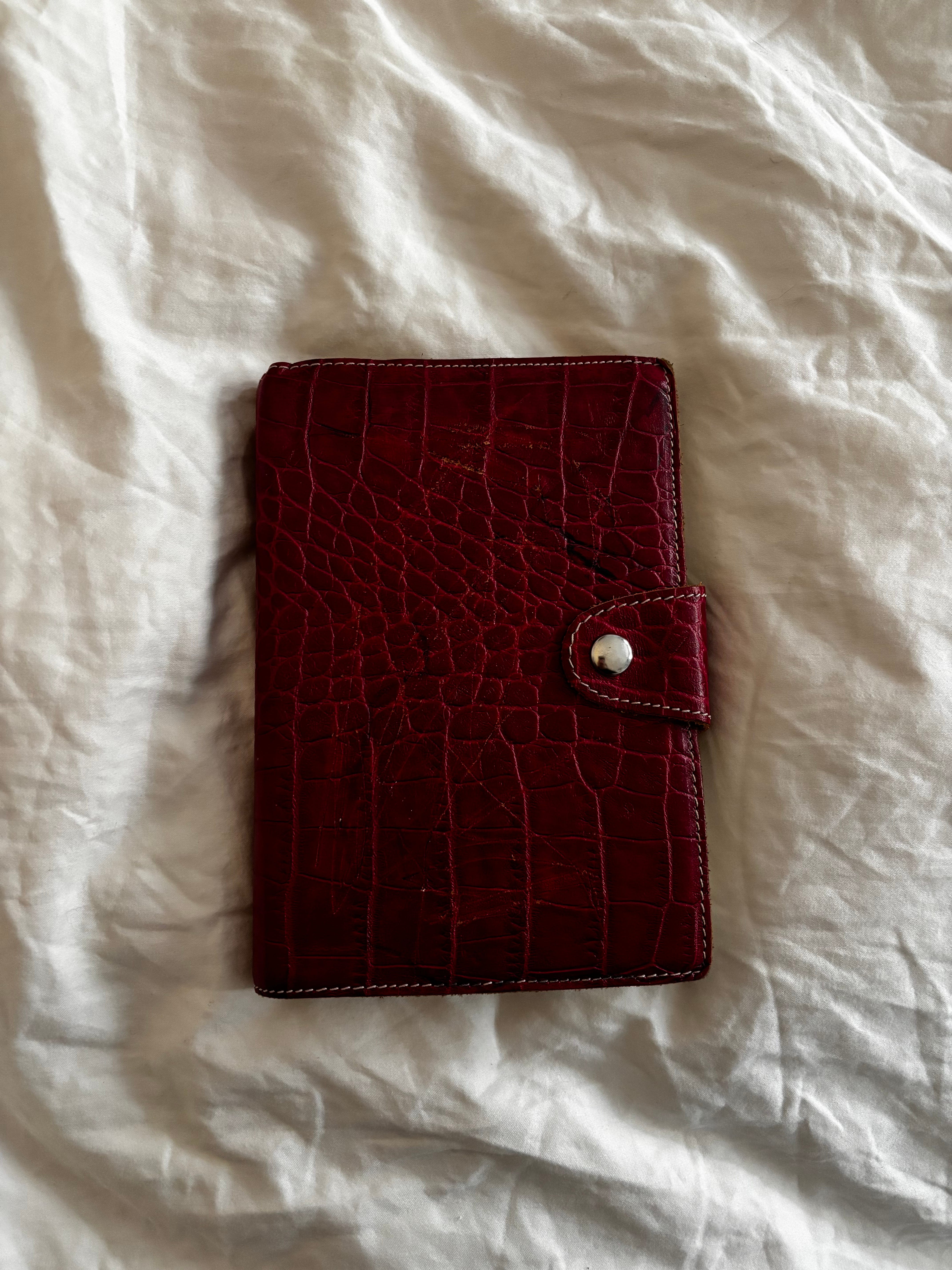
The notebook was probably purchased for me on the occasion of Christmas or my birthday, although I distinctly remember somehow that it was from TJ Maxx, the main place the women in my family went to buy or imagine buying things in the shape of style. Red leather snakeskin pattern, real leather, I think, bound with a little leather latch. “We hope you enjoy this product made by Florentine Artisans using the best quality of leather,” says a little inscription in Italic Times New Roman on the inside flyleaf, signed Francesco Lionetti, handmade in Italy. A company that still, according to my online searching, exists, but which mostly sells handbags and mostly advertises them on Instagram. When handling the notebook now, it occurs to me most directly that TJ Maxx would absolutely no longer sell such an item, the same way that even discount products or cheap things from 20 years ago now feel infinitely more solid, quality, materially real than the things you buy now even for expensive prices, due to the mass enshittification of the whole global supply chain. Or how TJ Maxx actually had a direct supplier of foreign or non-American semi-luxury goods back then, rather than the Nordstrom Rack polyester instant garbage fluff currently being shoveled into the fire.
The notebook now feels, even with its little distinctive half peeled-off TJ Maxx price tag on the back, the solid pink line at the top like an dried-up pregnancy test, like something solid and real. At the time, I had only recently come into possession of J.D. Salinger, furtively reading The Catcher in the Rye and then Franny and Zooey at Especially For Youth, the Mormon brainwashing camp teenagers are sent to from the ages of 12 to 18. And so I scratched some circles and lines and effusively meaningless cursive words into the leather surface, trying to give it some grittiness or texture or personality, a teenager’s sacrilege I’d have to hide strictly from whichever relative bought it for me.
****
The last week, I’ve developed something not unlike a cold — I’m not coughing or throat-sore, just congested and with achey and inflamed sinuses that require the evacuation of mucus at regular intervals. Going outside for more than five minutes requires Kleenex, which I carry with me now in little packets from a dollar store brand, NDONGEL, one of those Chinese discount brands that uses the imitation of English for marketing purposes. I imitated it a few times for Nina in my best clown voice: NNNNNDONGEL! NDONGEL? Ndongel… Ging you a comlaitable life, it says in little loopy handwriting, and I basically know what it means, don’t I? I’m not mocking, therefore, just reporting an innovative use-case of English, the ever-evolving language of capital. The slight raspier darkening of my speaking voice, due to congestion. Irritation of the philtrum and nasal membranes, redness I covered with MALLOW concealer from the brand ILIA, at the Union Square Sephora. I never wear such makeup but I’m having professional photos taken and was advised to get makeup done, professionally, which made me panic and wonder about wearing skin makeup for the first time in my life. “Does this shade match, do you think?” I asked, of the kind employee who stopped and asked me if I was doing okay, that most disarming of American consumer questions. Are. You. Doing. Okay. No, none of us are, that’s why we’re here! She advised me that it did, I couldn’t even tell you were wearing it! Great! I said. The important thing is to not have anyone tell you’re doing something, to not show that you’re exerting any effort.
****
There’s nothing original left to say about PureBarre, which I attended immediately after, my newly concealed face doubly concealed by my N95 mask in a way that I could tell made the other patrons wary and irritated. Nothing original left to say except that I was following the girl to my left for dear life, imitating her expertise and slender limbs, and was somewhat moved, if also intimidated, by her devotional focus, her reverence, as her black-fitted calf and white fluttered sock rose like a piston to the heavens, again and again, like some kind of harvest ritual, begging God to bless us with sponsored partnership, man who love, promotion, marble countertop.
Nothing original to say except that when Jia Tolentino wrote her essays in that boom of Esteemed Take-Foisting that happened between 2013 and 2018, and when I fell like a bonneted idiot into her marketing demographic, my head covered respectfully from the gaze of the Almighty, Hanif Abdurraqib was also writing his essays, and I didn’t read them at the time and this makes me mad now. I didn’t read enough in general, of course — that’s the brainwashing talking — because I was too busy annotating the sermons of the Prophet Lehi, over and over. Among other reasons. And anyway, Hanif and Jia share a register that I miss and forgot we had all moved on from: the impassioned and authoritative preacher of pop music, distancing from afar about some Liberal Principles. But Hanif’s writing is, not unexpectedly, more aware of itself, more conscious of the aubade of survival in its liturgy, less evasive and disgusted, as she tends to be, of the rot of death and failure and sincerity entering the room. And nothing original to say about Pure Barre except that when Jia Tolentino wrote the essay that launched a thousand normies to consider the existence of Cultural Criticism and Feminist Analysis, she made it seem as though the history of this kind of class was a history of femininity in general, a stream we’d all swim up, feigning protest, to get to some beautiful shore, eventually, rather than what it is, which is the comical concentration of extreme heterosexuality taken to its logical conclusion. Of course, to a straight fish, the river is straight, never curving, and straightness is both the water and the swim through it.
****
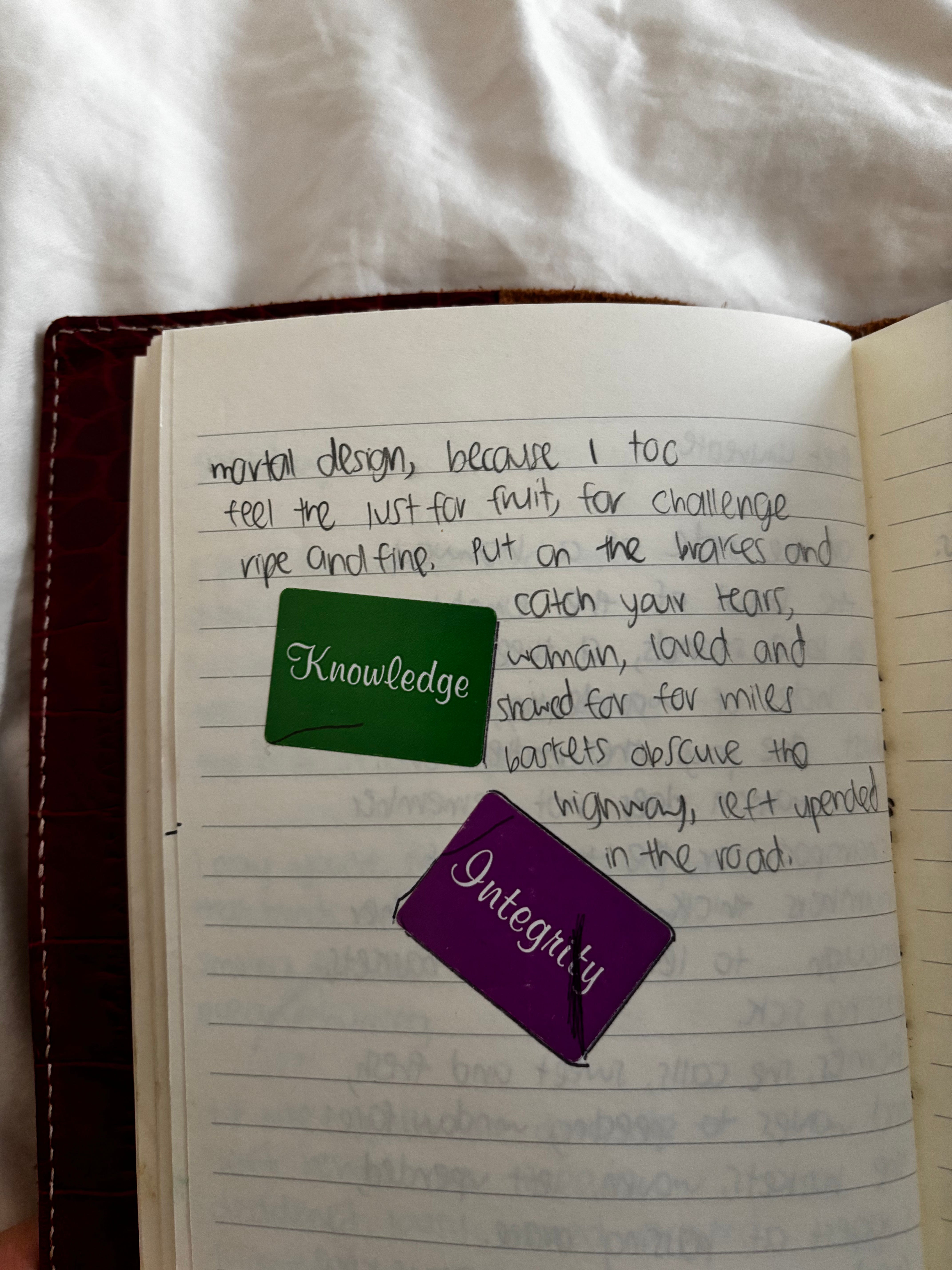
I took the red leather notebook with me through some of the most harrowing and miserable experiences of teenage-hood, that time when more of my peers were becoming conscious of their capacity to rebel and self-differentiate and when I became, although I wouldn’t have had language for this at the time, increasingly locked in to the confinement, psychological abuse, and isolation that are visited upon girls in my cult to keep us from envisioning any future other than lifelong inurement in the community and indentured servitude to a Worthy Priesthood Holder beginning at age 21. This era was also the genesis of the most vivid upswing of my eating disorder, when I discovered and began practicing behaviors that were psychically and physically self-demolishing, but roundly rewarded and encouraged by the adults around me, and a grim source of self-determination and autonomy I badly needed. KNOWLEDGE says one Kelly green sticker with rounded corners strewn on one page through a pile of my attempts at poetry, then INTEGRITY, purple. Such ephemera and tokens are common to all of my notebooks until a few years ago, when Mormonism’s constant lesson-teaching and scripture-reviewing meant that my internal monologue and note-keeping was constantly tripping through Church and Church activities, notes from talks or lessons or little folded up slips of paper with the passages or lessons I was supposed to memorize, What Does This Passage Make You Think About?
These stickers are from a set of what we call the Young Women’s Values. At the age of 12, Mormon youth graduate to a new level and type of socialization, brainwashing we might call it, which is more pointed and focused on an obsessive drive toward sexual purity and impending obedient adulthood. While the boys had their own programming, much of which was subsumed in the Church’s former partnership with the Boy Scouts of America and involved them doing things like “learning how to tie knots” and “going mountain biking,” the girl’s curriculum had to be invented out of whole cloth, and required much stricter surveillance, self-abasement, and the lessons of servitude, women and girls still still so marked by the long and visible imprint of Mormonism’s non-consensual polygamy that some sort of reverse retrofitted justification was still required to keep the whole project from falling apart. The Young Women’s Values are part of a sysphysian and tautological project of “self-improvement” requiring us to complete and check off “growth experiences” associated with each “value” as we progressed through the stages of the program (“Beehives,” the youngest, “MIA Maids,” the middle, and “Laurels,” the oldest, from 16 to 18). Every Sunday we lined up in the upper chamber of the meeting hall and recited, in unison, the Young Women’s theme, which said:
“We are daughters of our Heavenly Father, who loves us and we love Him. We will stand as witnesses of God at all times and in all things and in all places, as we strive to live the Young Women’s Values, which are: Faith, Divine Nature, Individual Worth, Knowledge, Choice and Accountability, Good Works, and Integrity. We believe as we come to accept and act upon these values, we will be able to strengthen home and family, make and keep sacred covenants, receive the ordinances of the temple, and enjoy the blessings of Exaltation.” The part about strengthening home and family was a new addition around the time I turned twelve, in the early 2000s, part of the Church’s panicked political response to mild resurgence in acceptance of LGBTQ people. Home and family are code for: being straight. Being simultaneously sexually inert and effusively beautiful. Not being weird about gender. Agreeing to the plan: marriage and children, at the right times, in the right ways. And above all: not questioning assimilation, not revealing your ugly feminine effort.
I reread my all my journals last summer. I cried because there was no development of self, just constant self-beratement for not achieving Mormon woman perfection. The doctrine was my yardstick and I was always coming up short. I left the church 3 years ago after a decade of deconstruction. I thought I was done. But then last year I realized I hadn’t deconstructed the false self I’d constructed to survive as a Mormon woman. So I’m in process.
I love you